Storing canned soup for emergencies
How long unopened canned soup keeps, how many cans your household needs and when to start using them.
Unopened canned soup keeps for 2–5 years (most canned soups (low-acid)) or 12–18 months (tomato soup (high-acid)) in a cool, dry pantry1. For 30 days, one adult would need about 375 cans on canned soup alone, or 94 cans as a quarter of their food. SupKit estimate
How long canned soup keeps
- USDA FoodKeeper suggests keeping unopened most canned soups (low-acid) in the pantry for 2–5 years from the date of purchase, for best quality.1
- USDA FoodKeeper suggests keeping unopened tomato soup (high-acid) in the pantry for 12–18 months from the date of purchase, for best quality.1
What the date on the label means
- Apart from infant formula, US federal law does not require quality date labels on packaged food.2
- 'Best if Used By' is about quality. Food past that date can still be eaten if it shows no spoilage or changes in colour, texture or consistency.2
Store canned soup somewhere cool and dry, and check each can for damage before you use it.
How much to store
SupKit estimates one canned soup 400g at about 180 calories, deliberately on the low side so stores aren't overestimated.3 An adult needs around 2,250 calories a day in SupKit's planning figures.
Nobody should live on one food, so this table assumes canned soup makes up a quarter of the food.
| Household | 3 days | 7 days | 14 days |
|---|---|---|---|
| One adult | 10 | 22 | 44 |
| Two adults | 19 | 44 | 88 |
| Two adults and two children | 33 | 75 | 150 |
The calculator above changes the household, the days and the share of food.
When to start using it
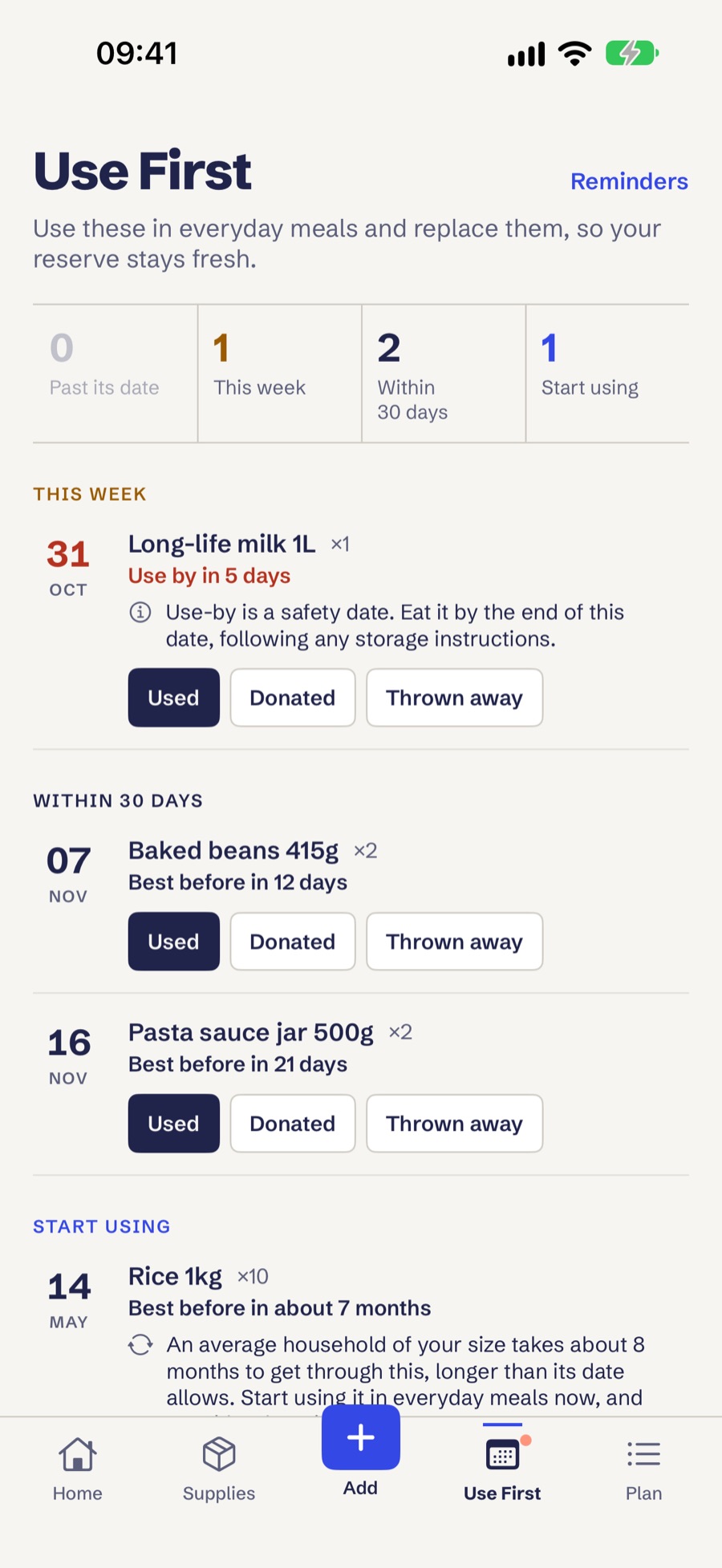
At everyday pace, two adults get through 44 cans of canned soup in about 11 weeks, so SupKit starts suggesting it about 13 weeks before the date.4
Eating your reserve in everyday meals and replacing it as you go keeps it fresh, so nothing ends up in the bin.
Allergies, dietary needs and children
Plan around everyone at home: allergies, intolerances and diets come first, and familiar food matters most for children. Recipes vary between brands, so always read the label of the product you buy.
| Food | Typical allergens | Typically suitable for |
|---|---|---|
| Canned soup | varies by recipe | vegetarian |
Typical allergens and diets are SupKit's guide to the main ingredient, not a product's label.
- US law names nine major food allergens: milk, eggs, fish, crustacean shellfish, tree nuts, peanuts, wheat, soybeans and sesame (sesame added from 2023).5
- Labels must name each major allergen's source, either in brackets in the ingredient list or in a 'Contains' statement next to it.5
- 'May contain' warnings are voluntary in the US, so not every maker uses them and their absence is not a guarantee.6
Young children
Questions
How long does canned soup last?
USDA FoodKeeper suggests keeping unopened most canned soups (low-acid) in the pantry for 2–5 years from the date of purchase, for best quality. USDA FoodKeeper suggests keeping unopened tomato soup (high-acid) in the pantry for 12–18 months from the date of purchase, for best quality. Always follow the date and storage instructions on the label.
How many cans of canned soup for 30 days?
For one adult, about 375 cans on canned soup alone, or 94 cans as a quarter of a mixed diet. This uses SupKit's estimate of 180 calories per can and 2,250 calories a day for an adult.
What allergens does canned soup contain?
Typically it varies by recipe. Recipes vary, so always read the label of the product you buy.
Sources
- FoodKeeper data (version 128), USDA Food Safety and Inspection Service. Checked 27 October 2026. Public domain (CC0).
- How to Cut Food Waste and Maintain Food Safety, U.S. Food and Drug Administration. Checked 28 October 2026.
- SupKit product catalogue (typical nutrition estimates), SupKit. SupKit's own planning data.
- SupKit Use First rotation rules (2026.1), SupKit. SupKit's own planning data.
- Food Allergies: What You Need to Know, U.S. Food and Drug Administration. Checked 28 October 2026.
- Have Food Allergies? Read the Label, U.S. Food and Drug Administration. Checked 28 October 2026.
- Choking Hazards | Infant and Toddler Nutrition, Centers for Disease Control and Prevention. Checked 28 October 2026.
- Foods and Drinks to Avoid or Limit | Infant and Toddler Nutrition, Centers for Disease Control and Prevention. Checked 28 October 2026.
fsis.usda.gov could not be resolved on 2026-10-27 (from the UK or US), so these values come from a public copy of FoodKeeper v128 retrieved 2026-09-28. Only unopened pantry fields are kept; they match a second independent copy for every product both contain (cross_checked). scripts/sync-foodkeeper.ts replaces this with the official file when the host is reachable.
We summarise official guidance in our own words. Always follow advice from your local authorities.