Shelf-stable milk in your emergency supplies
How many cartons of shelf-stable milk your household needs, what the date on the label means, and allergens to check.
Foods that keep longer than 90 days, like canned goods, dry pasta and frozen food, don't need a best-before date.1 For 30 days, one adult would need about 147 cartons on shelf-stable milk alone, or 37 cartons as a quarter of their food. SupKit estimate
What the date on the label means
- Foods that keep longer than 90 days, like canned goods, dry pasta and frozen food, don't need a best-before date.1
- Best-before dates are about freshness, not safety. You can buy and eat food after the date, though quality may drop.1
- Infant formula, meal replacements and similar products carry an expiration date; don't buy, sell or eat them once it has passed.1
Store shelf-stable milk somewhere cool and dry, and check each carton for damage before you use it.
How much to store
SupKit estimates one shelf-stable milk 1l at about 460 calories, deliberately on the low side so stores aren't overestimated.2 An adult needs around 2,250 calories a day in SupKit's planning figures.
Nobody should live on one food, so this table assumes shelf-stable milk makes up a quarter of the food.
| Household | 3 days | 7 days | 14 days |
|---|---|---|---|
| One adult | 4 | 9 | 18 |
| Two adults | 8 | 18 | 35 |
| Two adults and two children | 13 | 30 | 59 |
The calculator above changes the household, the days and the share of food.
When to start using it
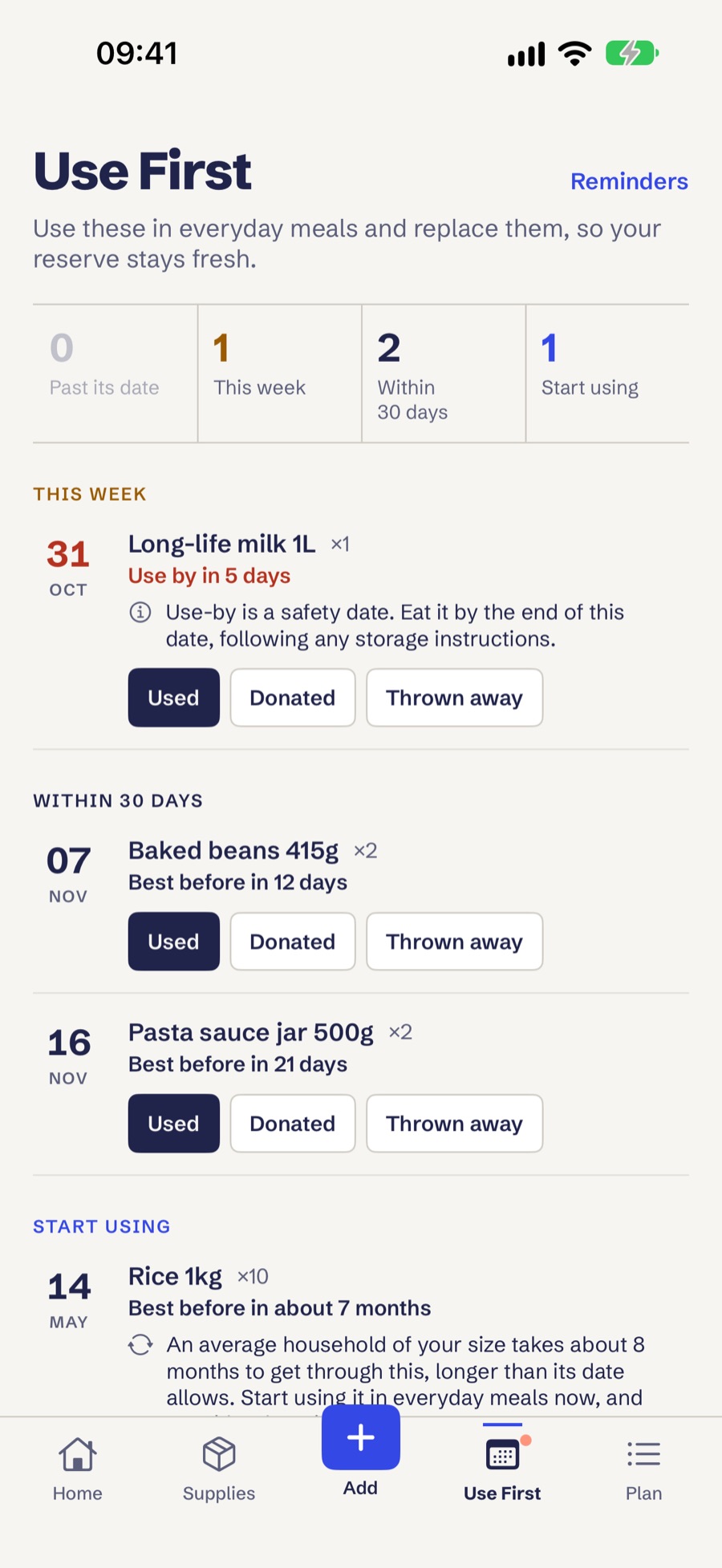
At everyday pace, two adults get through 18 cartons of shelf-stable milk in about 9 weeks, so SupKit starts suggesting it about 11 weeks before the date.3
Eating your reserve in everyday meals and replacing it as you go keeps it fresh, so nothing ends up in the bin.
Allergies, dietary needs and children
Plan around everyone at home: allergies, intolerances and diets come first, and familiar food matters most for children. Recipes vary between brands, so always read the label of the product you buy.
| Food | Typical allergens | Typically suitable for |
|---|---|---|
| Shelf-stable milk | milk | vegetarian, gluten free |
Typical allergens and diets are SupKit's guide to the main ingredient, not a product's label.
- Canada names 11 priority allergens: eggs, milk, mustard, peanuts, crustaceans and molluscs, fish, sesame, soy, sulphites, tree nuts, and wheat and triticale.4
- Packaged foods must declare priority allergens and gluten sources by plain source names in the ingredient list, a 'Contains' statement, or both.5
- Companies may add a 'May contain' warning for possible cross-contamination; it is not a substitute for good manufacturing practices.5
Young children
Questions
How many cartons of shelf-stable milk for 30 days?
For one adult, about 147 cartons on shelf-stable milk alone, or 37 cartons as a quarter of a mixed diet. This uses SupKit's estimate of 460 calories per carton and 2,250 calories a day for an adult.
What allergens does shelf-stable milk contain?
Typically milk. Recipes vary, so always read the label of the product you buy.
Sources
- Best before, expiration and more: Understanding the date labels on your food, Canadian Food Inspection Agency. Checked 28 October 2026.
- SupKit product catalogue (typical nutrition estimates), SupKit. SupKit's own planning data.
- SupKit Use First rotation rules (2026.1), SupKit. SupKit's own planning data.
- Food allergies, Health Canada. Checked 28 October 2026.
- Before you shop: food allergies and allergen labelling, Canadian Food Inspection Agency. Checked 28 October 2026.
- Nutrition for Healthy Term Infants: Recommendations from Six to 24 Months, Health Canada. Checked 28 October 2026.
- Infant botulism, Health Canada. Checked 28 October 2026.
We summarise official guidance in our own words. Always follow advice from your local authorities.