Emergency plan for medication and medical equipment
24 things to have ready for a household where someone relies on medication or medical equipment, with how much water and food to store for 2 adults.
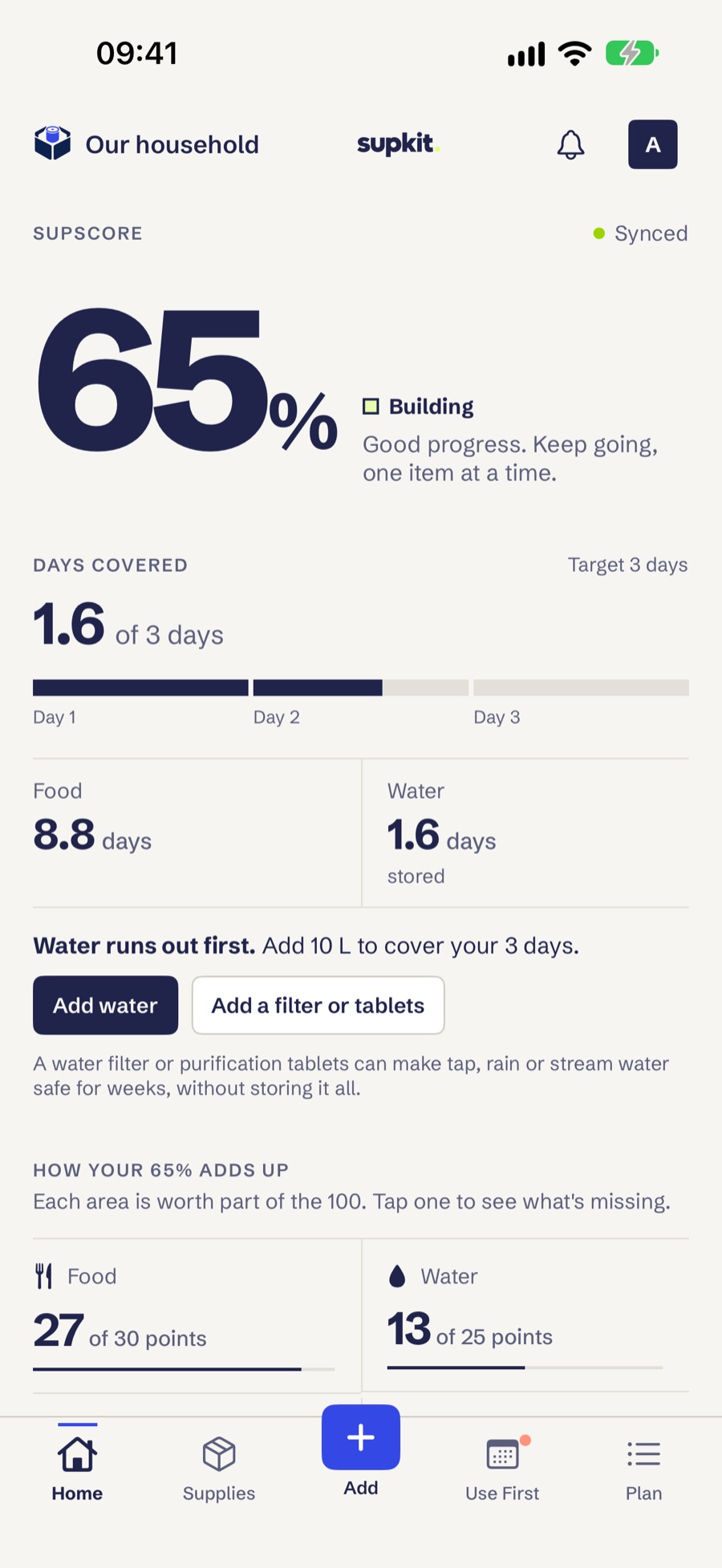
For 2 adults, store 4.8 gallons (18 L) of drinking water and about 13,500 calories of food for 3 days1, plus backup plan for powered equipment, essential medication, plan for medication that needs a fridge.
If someone relies on medication, medicine that needs a fridge or equipment that needs power, a little planning ahead makes a disruption much less stressful.
Who this plan is for
Two adults. SupKit's planning assumptions for this household:
| Who | Energy a day | Drinking water a day |
|---|---|---|
| Adult × 2 | 4,500 calories | 1.6 gallons (6 L) |
Water and food for 2 adults
| 3 days | 7 days | |
|---|---|---|
| Drinking water | 4.8 gallons (18 L) | 11.1 gallons (42 L) |
| Food energy | 13,500 calories | 31,500 calories |
What a household where someone relies on medication or medical equipment should add
- Backup plan for powered equipment Essential
A backup power source or plan for equipment that needs electricity. - Essential medication Essential
A supply of any medication your household relies on. - Plan for medication that needs a fridge Essential
Know how you'd keep it cool during a power outage.
What official guidance in the US says
- Have a backup plan for medicines that need refrigerating and for power-dependent medical devices.2
- A closed fridge keeps food cold for about four hours.2
Also on the US's official kit list
- The US basic kit includes a battery or hand-crank radio and a NOAA Weather Radio with tone alert.3
- US kits include a whistle to signal for help and a dust mask to filter contaminated air.3
- US kits include plastic sheeting, scissors and duct tape for sheltering in place.3
- US kits include a wrench or pliers to turn off utilities, plus a manual can opener.3
Everything else every home needs
- Food: food for everyone, manual can opener
- Water: drinking water
- Hygiene: hand sanitiser, wet wipes, toilet paper and bathroom products, personal hygiene supplies
- Power & warmth: flashlight, spare batteries, charged power bank, battery or wind-up radio, blankets or sleeping bags, camping stove, warm clothing
- Health & safety: first aid kit
- Plans & essentials: emergency contacts, meeting point, utility shut-offs, some cash, important documents, insurance details
See the full household checklist for what each one involves.
A sample shopping list for 3 days
One way to reach 13,500 calories with long-life food. SupKit estimate Swap in what your household likes.
| Item | How many |
|---|---|
| Canned chili | 7 |
| Canned soup | 8 |
| Baked beans | 7 |
| Microwave rice pouch 250g | 4 |
| Canned tuna | 6 |
| Crackers | 1 |
| Peanut butter | 1 |
| Dried fruit and nuts | 2 |
| Granola bars | 1 |
| Canned fruit | 4 |
Allergies, dietary needs and children
Plan around everyone at home: allergies, intolerances and diets come first, and familiar food matters most for children. Recipes vary between brands, so always read the label of the product you buy.
| Food | Typical allergens | Typically suitable for |
|---|---|---|
| Canned chili | varies by recipe | check the label |
| Canned soup | varies by recipe | vegetarian |
| Baked beans | none of the main allergens in its main ingredient | vegan |
| Microwave rice pouch 250g | none of the main allergens in its main ingredient | vegan |
| Canned tuna | fish | check the label |
| Crackers | cereals containing gluten | vegan |
| Peanut butter | peanuts | vegan, gluten free |
| Dried fruit and nuts | tree nuts | vegan, gluten free |
| Granola bars | varies by recipe | vegetarian |
| Canned fruit | none of the main allergens in its main ingredient | vegan, gluten free |
Typical allergens and diets are SupKit's guide to the main ingredient, not a product's label.
- US law names nine major food allergens: milk, eggs, fish, crustacean shellfish, tree nuts, peanuts, wheat, soybeans and sesame (sesame added from 2023).4
- Labels must name each major allergen's source, either in brackets in the ingredient list or in a 'Contains' statement next to it.4
- 'May contain' warnings are voluntary in the US, so not every maker uses them and their absence is not a guarantee.5
Young children
Questions
How much water should a household where someone relies on medication or medical equipment store?
4.8 gallons (18 L) for 3 days or 11.1 gallons (42 L) for a week, for 2 adults, at 3 litres per person per day.
What extra does a household where someone relies on medication or medical equipment need?
Backup plan for powered equipment: A backup power source or plan for equipment that needs electricity. Essential medication: A supply of any medication your household relies on. Plan for medication that needs a fridge: Know how you'd keep it cool during a power outage.
Sources
- SupKit planning rules (SupScore 2026.5), SupKit. SupKit's own planning data.
- Power Outages, Ready.gov (US DHS / FEMA). Checked 28 October 2026.
- Build a Kit, Ready.gov (US Department of Homeland Security / FEMA). Checked 28 October 2026.
- Food Allergies: What You Need to Know, U.S. Food and Drug Administration. Checked 28 October 2026.
- Have Food Allergies? Read the Label, U.S. Food and Drug Administration. Checked 28 October 2026.
- SupKit household preparedness checklist (2026.3), SupKit. SupKit's own planning data.
We summarise official guidance in our own words. Always follow advice from your local authorities.