Where am I supposed to keep all that bottled water?
You don't need a spare room full of bottles. What filters, tablets and boiling can and can't do, when stored water is essential, and a realistic hybrid plan.
Keep enough stored drinking water for the first few days, because filters, tablets and boiling all need a water source, and none of them work when the taps stop completely. Beyond that, a mix of refillable containers and a way to treat water can stretch your supply.
Official advice says to store water, and the numbers add up quickly. A family of four needs 36 L of drinking water for just three days, and 84 L for a week. That's a lot of bottles, and most homes don't have a spare room to put them in.
So what are the alternatives? Some are genuinely useful. Others are often misunderstood. Here's an honest comparison.
The storage problem
Water is heavy and bulky, and it has to be kept somewhere cool and dark, refreshed regularly and reachable in a hurry. Those are real constraints in a flat, a shared house or a small home. The answer isn't to give up on stored water; it's to store what matters most and plan sensibly for the rest.
How much water you actually need
Official guidance in Australia:
In SupKit's planning figures, here's what that means for common households:
| Household | 3 days | 7 days | 14 days |
|---|---|---|---|
| One adult | 9 L | 21 L | 42 L |
| Two adults | 18 L | 42 L | 84 L |
| Two adults and two children | 36 L | 84 L | 168 L |
| Two adults, a teenager and two children | 45 L | 105 L | 210 L |
Drinking water at SupKit's planning figure of 3 L per person per day. SupKit estimate
The calculator above works it out for yours, and the water storage guide covers drinking water versus water for washing and flushing.
Storage alternatives
- Refillable food-grade containers. Fill them from the tap, seal them, label them with the date and refresh them regularly. They're cheaper than bottles and often fit awkward spaces better.
- Several smaller containers rather than one big one, so they're easier to lift, carry and fit under beds or in cupboards.
- Filling extra containers when a warning is issued, such as before a forecast storm. Useful, but not a replacement for stored water, because some disruptions come without warning.
Filters
Portable filters can remove many particles and some germs from water, depending on the type. They need a water source to work, and most don't remove chemicals, fuel or salt. Floodwater and water that could be contaminated with chemicals isn't made safe by a filter. Follow the manufacturer's instructions and official advice where you live.
Purification tablets
Tablets can kill many germs in clear water when used exactly as directed, including the contact time. They don't remove chemicals, and they don't work as well in cloudy water. Like filters, they need a water source, and they have dates too.
Boiling
Boiling is a reliable way to kill germs in water from a safe supply, and it's what a boil water notice asks you to do. It needs power or fuel, which you may not have in a power cut, and it doesn't remove chemicals.
What happens when the taps stop completely?
This is the most important thing to understand. Filters, tablets and boiling all treat water you already have. If the supply stops altogether, as it can after a burst main, a major supply failure or a flood, there's nothing to treat. In that situation, the water you stored is the water you have.
That's why stored drinking water for the first few days is essential, and why treatment equipment can extend your supply but never replace it. Official advice during a water supply problem in Australia:
Comparing the options by scenario
| Situation | Stored water | Filter | Tablets | Boiling |
|---|---|---|---|---|
| Taps stop completely | Essential | Needs a source | Needs a source | Needs a source |
| Boil water notice | Useful | Follow the notice | Follow the notice | What the notice asks |
| Power cut, water still on | Useful | Not needed | Not needed | May not be possible |
| Floodwater or chemical contamination | Essential | Not safe | Not safe | Not safe |
A realistic hybrid plan
- Store drinking water for the first few days for everyone at home, plus pets. For two adults, that's 18 L.
- Use refillable containers to keep it compact and cheap, and refresh them regularly.
- Add a way to treat water from a safe source, such as tablets or a filter suited to your situation, to extend your supply if the disruption lasts.
- Know where else you could get water, such as bottled water stations during a long outage, from official updates.
- Track it all, so nothing goes past its date.
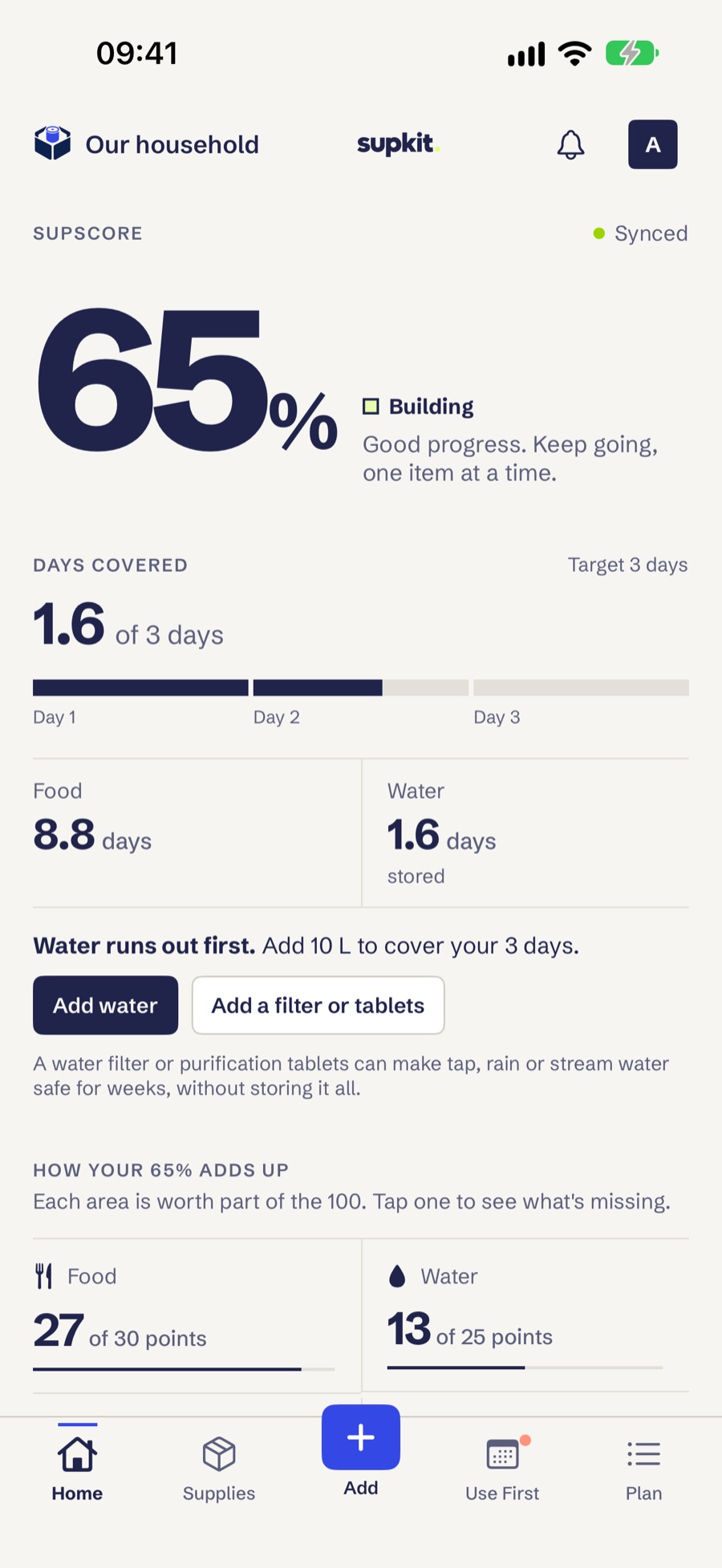
SupKit works out your household's water target, keeps track of what you've stored and reminds you when it's due for refreshing.
Questions
Can I use a water filter instead of storing water?
Not entirely. Filters need a water source and most don't remove chemicals. Keep stored drinking water for the first few days, and use a filter to extend your supply from a safe source.
Do purification tablets make any water safe?
No. They kill many germs in clear water when used as directed, but they don't remove chemicals, and floodwater isn't made safe by tablets.
How can I store emergency water in a small home?
Use several smaller refillable food-grade containers in cool, dark spots, such as under beds or at the bottom of wardrobes, and refresh them regularly.
Sources
- Emergency kit - Get Ready Queensland, Queensland Government (Queensland Reconstruction Authority). Checked 28 October 2026.
- Food safety in an emergency, Food Standards Australia New Zealand. Checked 29 October 2026.
- Food safety after an emergency or natural disaster, Queensland Health (qld.gov.au). Checked 29 October 2026.
- Floods and food safety, Food Standards Australia New Zealand. Checked 29 October 2026.
- Drinking water during and after a disaster, Queensland Health. Checked 28 October 2026.
- Food and drinking water, Queensland Government (qld.gov.au). Checked 29 October 2026.
- Tropical Cyclone - FAQs, Queensland Government (Get Ready Queensland). Checked 28 October 2026.
- SupKit planning rules (SupScore 2026.5), SupKit. SupKit's own planning data.
We summarise official guidance in our own words. Always follow advice from your local authorities.