The family emergency preparedness checklist
A plan that covers everyone under your roof: babies, children, older relatives, medication, disabilities and pets, with roles, contacts and a printable checklist.
Start with who lives with you and what each person needs, then cover supplies, dependants, how you'll stay in touch, emergency contacts and a meeting place. Practise the plan and review it whenever your household changes.
No two households are the same, so no single checklist fits everyone. A family with a newborn, a couple caring for an older parent, and a household with a dog and a child with asthma all need different things. This guide helps you build a plan around the people actually under your roof.
Step 1: identify everyone's needs
Go through your household one person at a time, pets included, and note:
- Age, as babies, children and older adults need different food, water and care.
- Health: regular medication, medicine that needs a fridge, powered medical equipment, allergies and diets.
- Mobility and access needs, including anyone who'd need help to leave the house.
- Communication needs, such as hearing or sight loss, or a language other than English.
- Pets and assistance animals.
SupKit's planning figures by age give you a starting point for food and water:
| Age band | Energy a day | Drinking water a day |
|---|---|---|
| Baby | Planned separately (feeding supplies) | 3 L |
| Toddler | 4,602 kJ (1,100 Cal) | 3 L |
| Child | 6,694 kJ (1,600 Cal) | 3 L |
| Teenager | 10,042 kJ (2,400 Cal) | 3 L |
| Adult | 9,414 kJ (2,250 Cal) | 3 L |
| Older adult | 8,368 kJ (2,000 Cal) | 3 L |
SupKit's planning figures, the same ones the app uses. SupKit estimate
Step 2: supplies
For two adults and two children, three days is 36 L of drinking water and about 96,650 kJ (23,100 Cal) of food. The 72-hour kit checklist covers everything else.
Step 3: dependants
- Babies: their usual milk or formula, bottles, nappies, wipes and spare clothes.
- Children: familiar food, comfort items, something to do, and copies of any medical information. Make sure school or childcare knows who can collect them.
- Older relatives: medication, glasses, hearing aids and spare batteries, warm clothing, and someone who checks in on them.
- Medication and medical equipment: a supply of regular medicines, copies of prescriptions, and a plan for power cuts if anything needs electricity or a fridge.
Step 4: a communication plan
Agree how you'll contact each other if you're apart, and what you'll do if phones don't work. Choose a meeting place near home and one further away. Decide who collects the children and who checks on older relatives.
Step 5: emergency contacts
Write them on paper as well as in your phones: family, a contact outside your area, neighbours, doctors, schools, your vet, your electricity, gas and water companies and your insurer. Keep a copy in your kit.
Step 6: pets
Plan for your pets' food, water and medication, and how you'd take them with you if you had to leave.
Step 7: practise
Talk the plan through together, especially with children, so everyone knows where the kit is, how to turn off the utilities and where to meet. A short practice once a year makes it second nature.
Step 8: review
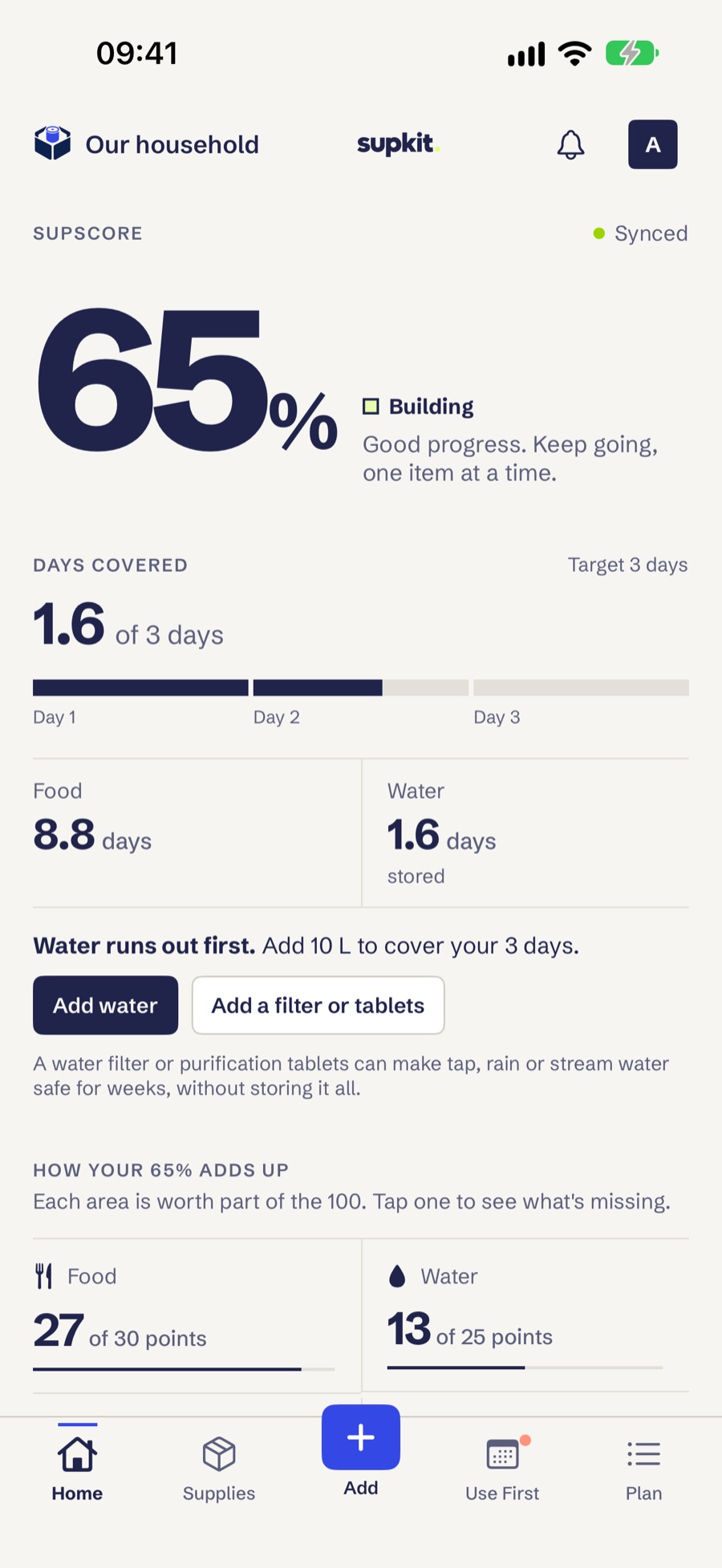
Review the plan whenever your household changes: a new baby, a new pet, a new medication or a move. SupKit asks who's at home and builds the checklist around them, so the plan changes when your household does.
The printable checklist
Food
- Food for everyone Essential
Non-perishable food that will last your household for your chosen number of days. - Baby and toddler feeding supplies Essential If you have a baby or toddler
Enough formula, milk or baby food for babies and toddlers, plus bottles, cups and sterilising supplies. - Food your children will eat If you have children
Familiar foods and snacks your children are happy to eat. - Pet food Essential If you have pets
Enough of your pets' usual food for your chosen number of days. - Manual tin opener
A tin opener that doesn't need electricity.
Water
- Drinking water Essential
3 L per person per day for drinking is the commonly recommended amount. - Water for pets Essential If you have pets
An estimate based on each pet's species and size.
Hygiene
- Hand sanitiser
For when running water isn't available. - Wet wipes
Useful for cleaning when water is limited. - Toilet roll and bathroom products
Toilet roll, bin bags and other bathroom basics. - Personal hygiene supplies
Toothpaste, soap, period products and anything else your household uses daily. - Nappies and baby wipes Essential If you have a baby or toddler
Enough nappies and wipes for your chosen number of days.
Power & warmth
- Torch Essential
A torch for each part of the home you'd need to move around in the dark. - Spare batteries
The right sizes for your torch and radio. - Charged power bank
To keep a phone charged during a power cut. - Battery or wind-up radio
To hear updates if mobile networks are down. - Blankets or sleeping bags
To keep everyone warm if the heating is off. - Warm clothing
Layers, hats and gloves that are easy to find. - Backup plan for powered equipment Essential If anyone relies on powered medical equipment
A backup power source or plan for equipment that needs electricity.
Health & safety
- First aid kit Essential
A stocked first aid kit that everyone knows where to find. - Essential medication Essential If anyone takes regular medication
A supply of any medication your household relies on. - Plan for medication that needs a fridge Essential If medication needs a fridge
Know how you'd keep it cool during a power cut. - Mobility and accessibility plan Essential If anyone has mobility or access needs
How anyone with mobility or access needs would get help or leave home. - Pet medication and records If you have pets
Any medication your pets need, plus vet and vaccination details.
Plans & essentials
- Emergency contacts Essential
Important numbers saved where you can reach them without the internet. - Meeting point
Somewhere your household agrees to meet if you're separated. - Utility shut-offs
Where to turn off water, gas and electricity. - Some cash
Card machines and cash points may not work in a power cut. - Important documents
Know where your important documents are kept. SupKit never asks you to upload them. - Insurance details
Policy numbers and claim lines for home and contents insurance. - Children's arrangements If you have children
School or childcare contacts and who would collect your children. - Pet carrier and lead If you have pets
What you'd need to take your pets with you.
SupKit's checklist, the one the app tracks. SupKit's own household preparedness checklist. Only drinking water (3 litres per person per day) and the 3-day starting target are numeric amounts; every other item is a checklist item. It isn't official advice: always follow instructions from your local emergency services.
Questions
What should a family emergency plan include?
Everyone's needs, supplies for a few days, plans for babies, children, older relatives, medication and pets, how you'll contact each other, emergency contacts, a meeting place and who does what.
How do I make an emergency plan with children?
Keep it simple and calm. Show them where the kit is, teach them key phone numbers and the meeting place, and practise together.
How often should we review our family emergency plan?
At least once a year, and whenever your household changes, such as a new baby, a new pet or new medication.
Sources
- Step 4: Get packing, Australian Red Cross. Checked 29 October 2026.
- Emergency kit - Get Ready Queensland, Queensland Government (Queensland Reconstruction Authority). Checked 28 October 2026.
- Nuts and seeds, Better Health Channel, Department of Health, State Government of Victoria. Checked 28 October 2026.
- Introducing solid food, Pregnancy, Birth and Baby (Healthdirect Australia, funded by the Australian Government). Checked 28 October 2026.
- Step 2: Get connected, Australian Red Cross. Checked 29 October 2026.
- Make a household emergency plan, Get Ready Queensland (Queensland Government). Checked 29 October 2026.
- Step 3: Get organised, Australian Red Cross. Checked 29 October 2026.
- Protect your pets, Get Ready Queensland (Queensland Government). Checked 29 October 2026.
- SupKit planning rules (SupScore 2026.5), SupKit. SupKit's own planning data.
- SupKit household preparedness checklist (2026.3), SupKit. SupKit's own planning data.
We summarise official guidance in our own words. Always follow advice from your local authorities.