Household emergency kit checklist
21 things to have ready for a household, with how much water and food to store for 2 adults.
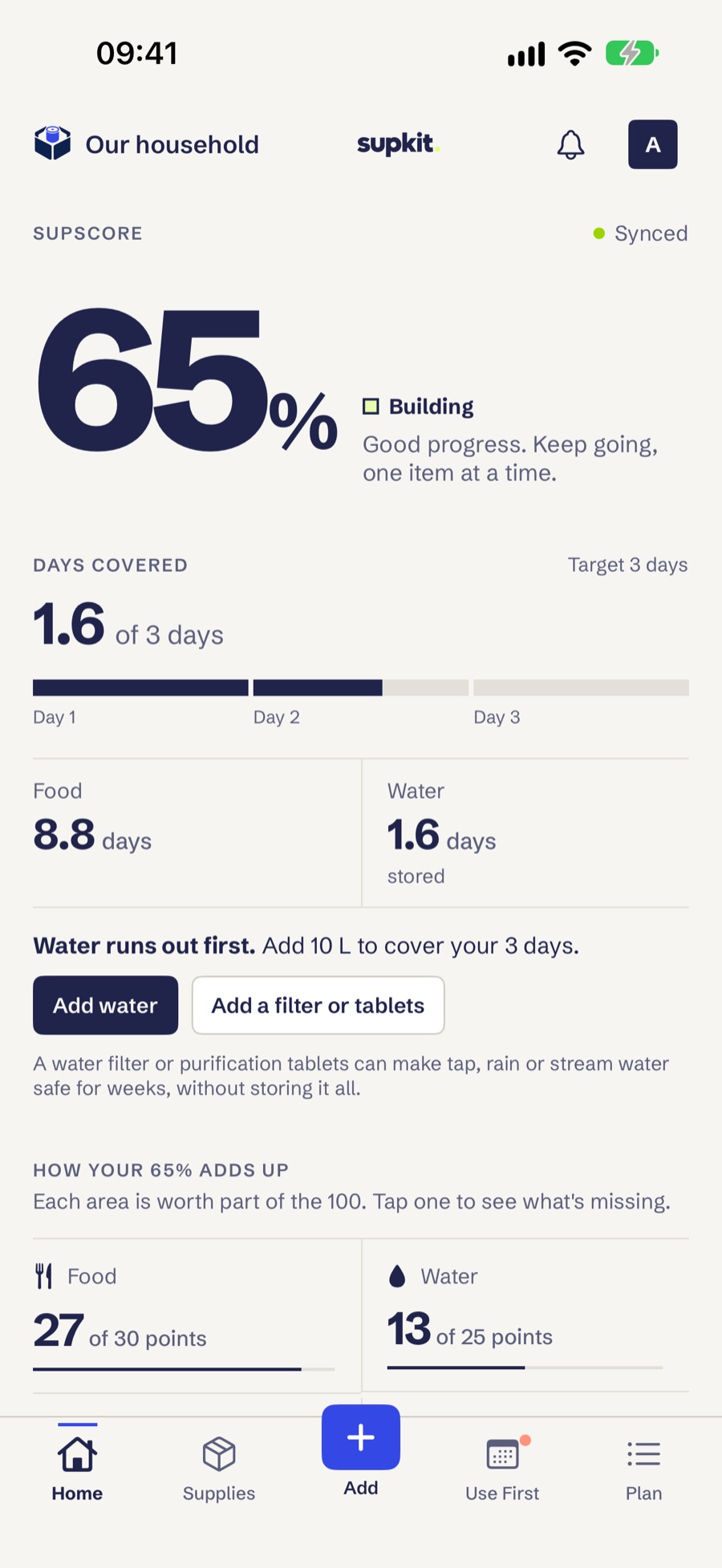
For 2 adults, store 18 L of drinking water and about 13,500 calories of food for 3 days1.
Every home needs the same core kit: water, food, light, warmth, information and a plan. This is the full list, sized here for two adults, with notes for people living alone and older households.
Who this plan is for
Two adults. SupKit's planning assumptions for this household:
| Who | Energy a day | Drinking water a day |
|---|---|---|
| Adult × 2 | 4,500 calories | 6 L |
Water and food for 2 adults
| 3 days | 7 days | |
|---|---|---|
| Drinking water | 18 L | 42 L |
| Food energy | 13,500 calories | 31,500 calories |
Also on Canada's official kit list
- Canada's kit list includes a corded phone, chargers, a flashlight, a radio and spare batteries.2
Food
- Food for everyone Essential
Non-perishable food that will last your household for your chosen number of days. - Manual can opener
A can opener that doesn't need electricity.
Water
- Drinking water Essential
3 litres per person per day for drinking is the commonly recommended amount.
Hygiene
- Hand sanitiser
For when running water isn't available. - Wet wipes
Useful for cleaning when water is limited. - Toilet paper and bathroom products
Toilet paper, bin bags and other bathroom basics. - Personal hygiene supplies
Toothpaste, soap, period products and anything else your household uses daily.
Power & warmth
- Flashlight Essential
A flashlight for each part of the home you'd need to move around in the dark. - Spare batteries
The right sizes for your flashlight and radio. - Charged power bank
To keep a phone charged during a power outage. - Battery or wind-up radio
To hear updates if cell networks are down. - Blankets or sleeping bags
To keep everyone warm if the heating is off. - Camping stove
A way to heat food and water without mains power, with spare fuel. Only use it outdoors or somewhere well ventilated. - Warm clothing
Layers, hats and gloves that are easy to find.
Health & safety
- First aid kit Essential
A stocked first aid kit that everyone knows where to find.
Plans & essentials
- Emergency contacts Essential
Important numbers saved where you can reach them without the internet. - Meeting point
Somewhere your household agrees to meet if you're separated. - Utility shut-offs
Where to turn off water, gas and electricity. - Some cash
Card machines and cash points may not work in a power outage. - Important documents
Know where your important documents are kept. SupKit never asks you to upload them. - Insurance details
Policy numbers and claim lines for home and contents insurance.
A sample shopping list for 3 days
One way to reach 13,500 calories with long-life food. SupKit estimate Swap in what your household likes.
| Item | How many |
|---|---|
| Canned chili | 7 |
| Canned soup | 8 |
| Baked beans | 7 |
| Microwave rice pouch 250g | 4 |
| Canned tuna | 6 |
| Crackers | 1 |
| Peanut butter | 1 |
| Dried fruit and nuts | 2 |
| Granola bars | 1 |
| Canned fruit | 4 |
Allergies, dietary needs and children
Plan around everyone at home: allergies, intolerances and diets come first, and familiar food matters most for children. Recipes vary between brands, so always read the label of the product you buy.
| Food | Typical allergens | Typically suitable for |
|---|---|---|
| Canned chili | varies by recipe | check the label |
| Canned soup | varies by recipe | vegetarian |
| Baked beans | none of the main allergens in its main ingredient | vegan |
| Microwave rice pouch 250g | none of the main allergens in its main ingredient | vegan |
| Canned tuna | fish | check the label |
| Crackers | cereals containing gluten | vegan |
| Peanut butter | peanuts | vegan, gluten free |
| Dried fruit and nuts | tree nuts | vegan, gluten free |
| Granola bars | varies by recipe | vegetarian |
| Canned fruit | none of the main allergens in its main ingredient | vegan, gluten free |
Typical allergens and diets are SupKit's guide to the main ingredient, not a product's label.
- Canada names 11 priority allergens: eggs, milk, mustard, peanuts, crustaceans and molluscs, fish, sesame, soy, sulphites, tree nuts, and wheat and triticale.3
- Packaged foods must declare priority allergens and gluten sources by plain source names in the ingredient list, a 'Contains' statement, or both.4
- Companies may add a 'May contain' warning for possible cross-contamination; it is not a substitute for good manufacturing practices.4
Young children
Questions
How much water should a household store?
18 L for 3 days or 42 L for a week, for 2 adults, at 3 litres per person per day.
Sources
- SupKit planning rules (SupScore 2026.5), SupKit. SupKit's own planning data.
- Emergency kits - Canada.ca, Government of Canada (Public Safety Canada). Checked 27 October 2026.
- Food allergies, Health Canada. Checked 28 October 2026.
- Before you shop: food allergies and allergen labelling, Canadian Food Inspection Agency. Checked 28 October 2026.
- SupKit household preparedness checklist (2026.3), SupKit. SupKit's own planning data.
We summarise official guidance in our own words. Always follow advice from your local authorities.