The complete 72-hour emergency kit checklist
What your household needs for the first 72 hours of an emergency: official guidance for Ireland, a printable checklist, and extras for children, pets and medication.
A 72-hour kit covers three days at home without shops, power or running water: drinking water, long-life food, light, a radio, warmth, first aid, medication, copies of documents and a plan. For two adults that's 18 L of drinking water to start.
An emergency kit can feel like a big project, so it helps to know what it's for. A 72-hour kit is about the first three days of a disruption: a power cut, a storm, a flood warning or a problem with the water supply, when shops may be shut and services stretched. It's not about the end of the world. It's about getting through a hard few days calmly.
This checklist separates what official guidance in Ireland recommends from SupKit's own suggestions, and it has extras for children, pets and medical needs. You can print it and tick things off as you go.
What 72 hours means
Three days is a common starting point because it covers the time it can take for help and services to reach everyone after a major incident. Official guidance in Ireland says:
If you live somewhere remote, or somewhere that is often cut off, plan for longer. Many households build towards a week or two once the first few days are covered.
What official guidance in Ireland recommends
Food and water
Water comes first. People can manage without food for longer than without water, and water also matters for medication, hygiene and pets.
| Household | 3 days | 7 days | 14 days |
|---|---|---|---|
| One adult | 9 L | 21 L | 42 L |
| Two adults | 18 L | 42 L | 84 L |
| Two adults and two children | 36 L | 84 L | 168 L |
| Two adults, a teenager and two children | 45 L | 105 L | 210 L |
Drinking water at SupKit's planning figure of 3 L per person per day. SupKit estimate
For food, choose long-life food your household already eats, and enough of it for everyone. For two adults, three days is about 13,500 calories. The food quantities guide works it out for other households.
Hygiene
Hand sanitiser, wet wipes, toilet roll, sanitary products and bin bags make a few days without running water far more bearable, and they help stop illness spreading at home.
Power, light and warmth
A torch for each adult, spare batteries, a charged power bank and a battery or wind-up radio cover most power cuts. Warm clothes and blankets matter in winter, especially for babies and older people.
Medical needs
Keep a supply of any regular medication, a first aid kit, and copies of prescriptions. If anyone relies on medication that needs a fridge or on powered medical equipment, plan for a power cut now: talk to your pharmacist, doctor or equipment supplier about what to do. The first aid kit guide covers what to keep.
Documents and money
Copies of important documents in a waterproof bag, a list of emergency contacts on paper, and some cash in small notes in case card machines are down.
Pets
Pets need their own food, water and any medication, plus a lead, carrier and their records. Remember them in your plan too.
The printable checklist
This is SupKit's household checklist, the one the app tracks. Items marked "if you have…" only apply to some homes. Tick off what you already have; most homes are further along than they think.
Food
- Food for everyone Essential
Non-perishable food that will last your household for your chosen number of days. - Baby and toddler feeding supplies Essential If you have a baby or toddler
Enough formula, milk or baby food for babies and toddlers, plus bottles, cups and sterilising supplies. - Food your children will eat If you have children
Familiar foods and snacks your children are happy to eat. - Pet food Essential If you have pets
Enough of your pets' usual food for your chosen number of days. - Manual tin opener
A tin opener that doesn't need electricity.
Water
- Drinking water Essential
3 L per person per day for drinking is the commonly recommended amount. - Water for pets Essential If you have pets
An estimate based on each pet's species and size.
Hygiene
- Hand sanitiser
For when running water isn't available. - Wet wipes
Useful for cleaning when water is limited. - Toilet roll and bathroom products
Toilet roll, bin bags and other bathroom basics. - Personal hygiene supplies
Toothpaste, soap, period products and anything else your household uses daily. - Nappies and baby wipes Essential If you have a baby or toddler
Enough nappies and wipes for your chosen number of days.
Power & warmth
- Torch Essential
A torch for each part of the home you'd need to move around in the dark. - Spare batteries
The right sizes for your torch and radio. - Charged power bank
To keep a phone charged during a power cut. - Battery or wind-up radio
To hear updates if mobile networks are down. - Blankets or sleeping bags
To keep everyone warm if the heating is off. - Warm clothing
Layers, hats and gloves that are easy to find. - Backup plan for powered equipment Essential If anyone relies on powered medical equipment
A backup power source or plan for equipment that needs electricity.
Health & safety
- First aid kit Essential
A stocked first aid kit that everyone knows where to find. - Essential medication Essential If anyone takes regular medication
A supply of any medication your household relies on. - Plan for medication that needs a fridge Essential If medication needs a fridge
Know how you'd keep it cool during a power cut. - Mobility and accessibility plan Essential If anyone has mobility or access needs
How anyone with mobility or access needs would get help or leave home. - Pet medication and records If you have pets
Any medication your pets need, plus vet and vaccination details.
Plans & essentials
- Emergency contacts Essential
Important numbers saved where you can reach them without the internet. - Meeting point
Somewhere your household agrees to meet if you're separated. - Utility shut-offs
Where to turn off water, gas and electricity. - Some cash
Card machines and cash points may not work in a power cut. - Important documents
Know where your important documents are kept. SupKit never asks you to upload them. - Insurance details
Policy numbers and claim lines for home and contents insurance. - Children's arrangements If you have children
School or childcare contacts and who would collect your children. - Pet carrier and lead If you have pets
What you'd need to take your pets with you.
SupKit's checklist, the one the app tracks. SupKit's own household preparedness checklist. Only drinking water (3 litres per person per day) and the 3-day starting target are numeric amounts; every other item is a checklist item. It isn't official advice: always follow instructions from your local emergency services.
Keep it ready
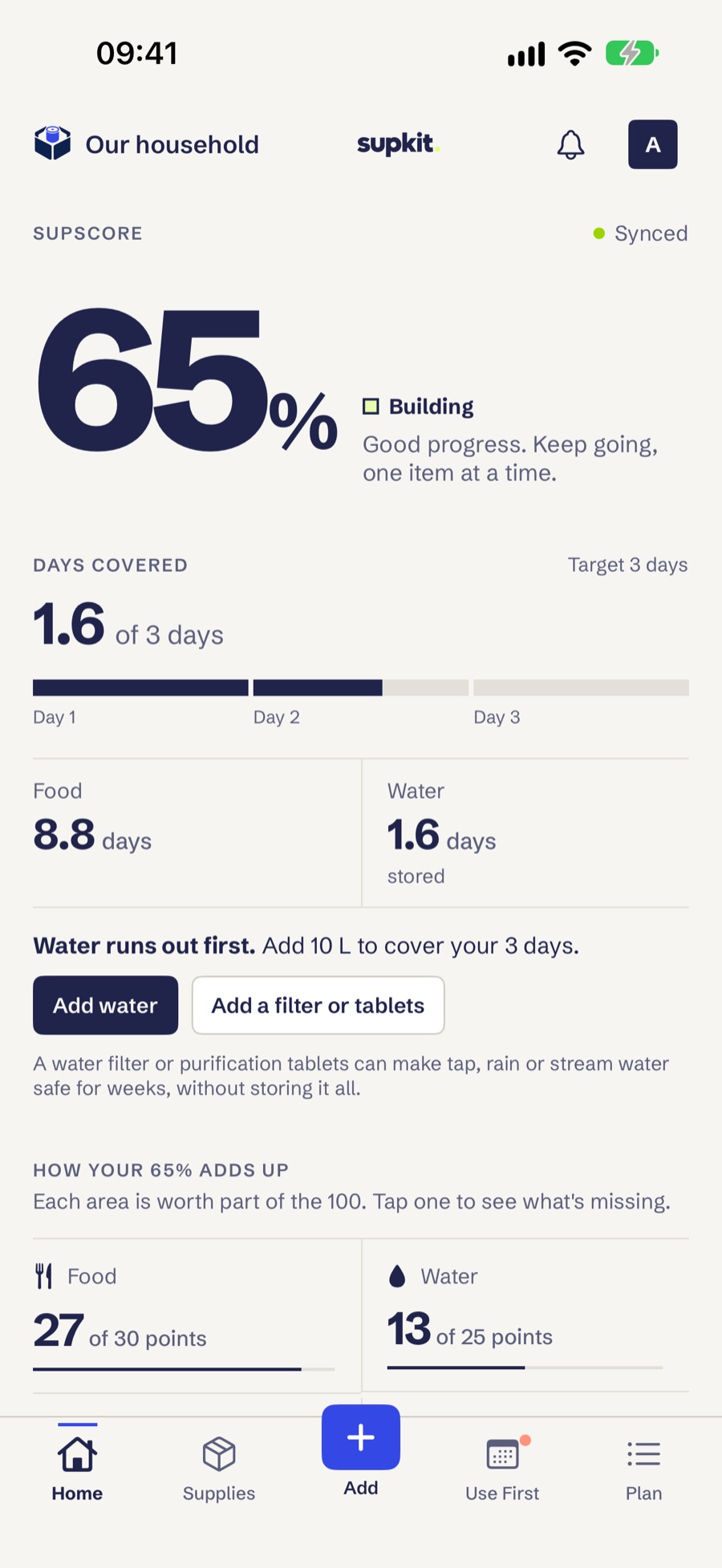
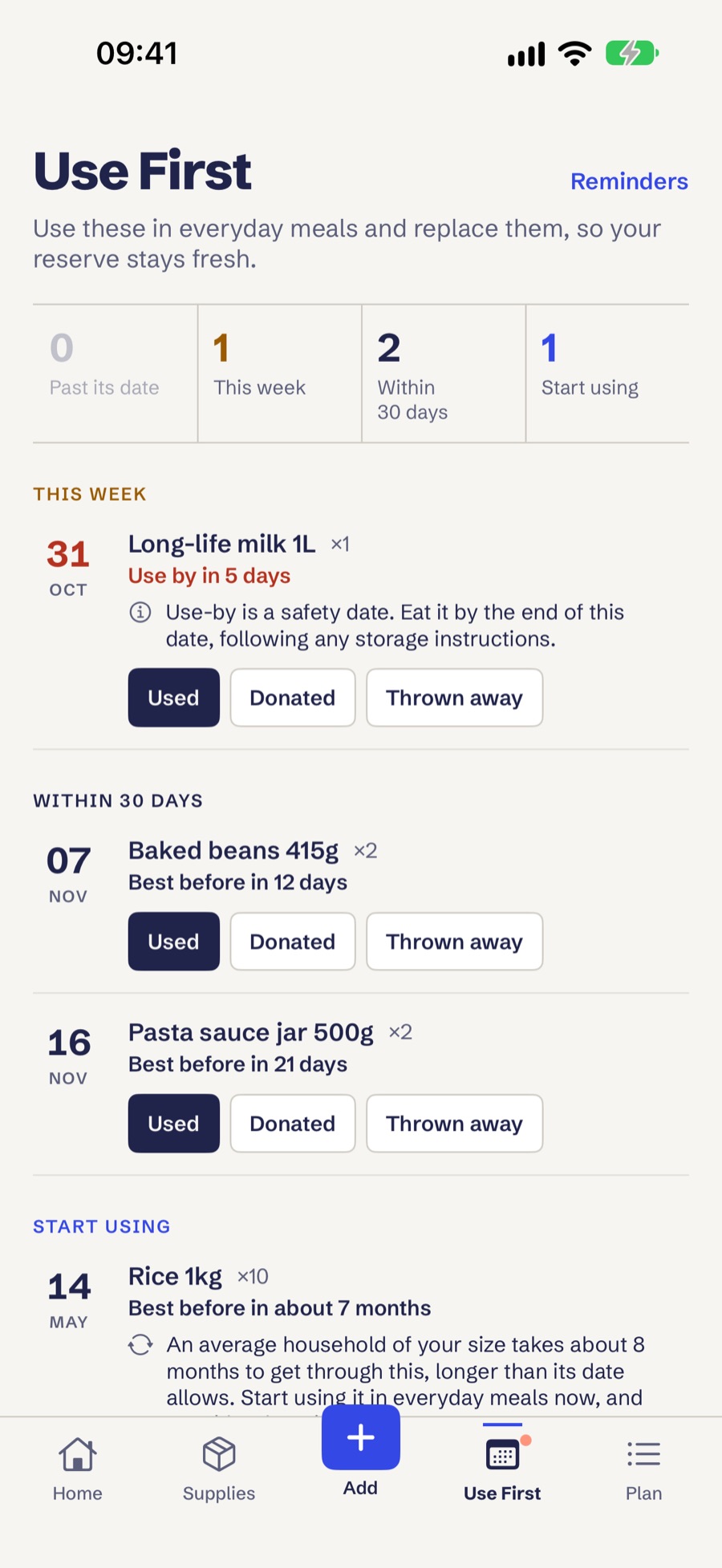
A kit only helps if it's still complete when you need it. Check it every few months, replace anything you've used, and keep an eye on dates. SupKit reminds you before food and water go out of date and keeps your checklist up to date as your household changes.
Questions
What should be in a 72-hour emergency kit?
Drinking water, long-life food, a torch, a radio, spare batteries, a first aid kit, medication, hygiene items, warm clothing, cash, copies of documents and a household plan, plus extras for babies, children, pets and medical needs.
How much water do I need for 72 hours?
For two adults, <strong>18 L</strong> of drinking water at SupKit's planning figure. Check official guidance in Ireland and add more for pets, hygiene and hot weather.
Is a 72-hour kit enough?
It's a good first goal. If you live somewhere that can be cut off for longer, or official guidance where you live suggests more, build up towards a week or two over time.
Sources
- Be Emergency Ready booklet (accessible version), Department of Defence, Office of Emergency Planning (Government of Ireland). Checked 28 October 2026.
- Loss of utilities (Be Emergency Ready), Government of Ireland (Office of Emergency Planning). Checked 28 October 2026.
- Preparing for severe weather conditions, ESB Networks. Checked 29 October 2026.
- Storms (Be Emergency Ready), Government of Ireland (Office of Emergency Planning). Checked 28 October 2026.
- Boil Water Notice, Uisce Éireann. Checked 28 October 2026.
- SupKit planning rules (SupScore 2026.5), SupKit. SupKit's own planning data.
- SupKit household preparedness checklist (2026.3), SupKit. SupKit's own planning data.
We summarise official guidance in our own words. Always follow advice from your local authorities.