How much emergency food do you need for 3, 7 or 14 days?
Work out how much long-life food your household needs for 3, 7 or 14 days, based on who lives with you, not a one-size-fits-all number of tins.
For two adults, 3 days of food is about 56,484 kJ (13,500 Cal) in SupKit's planning figures, and a week is about 131,796 kJ (31,500 Cal). Children, older adults and anyone with dietary needs change the picture, so plan around the people at home.
Most people guess. They buy a few extra tins, put them at the back of the cupboard and hope it's enough. The trouble is that "enough" depends entirely on who lives with you, and a pile of tins tells you very little about how many days it would actually last.
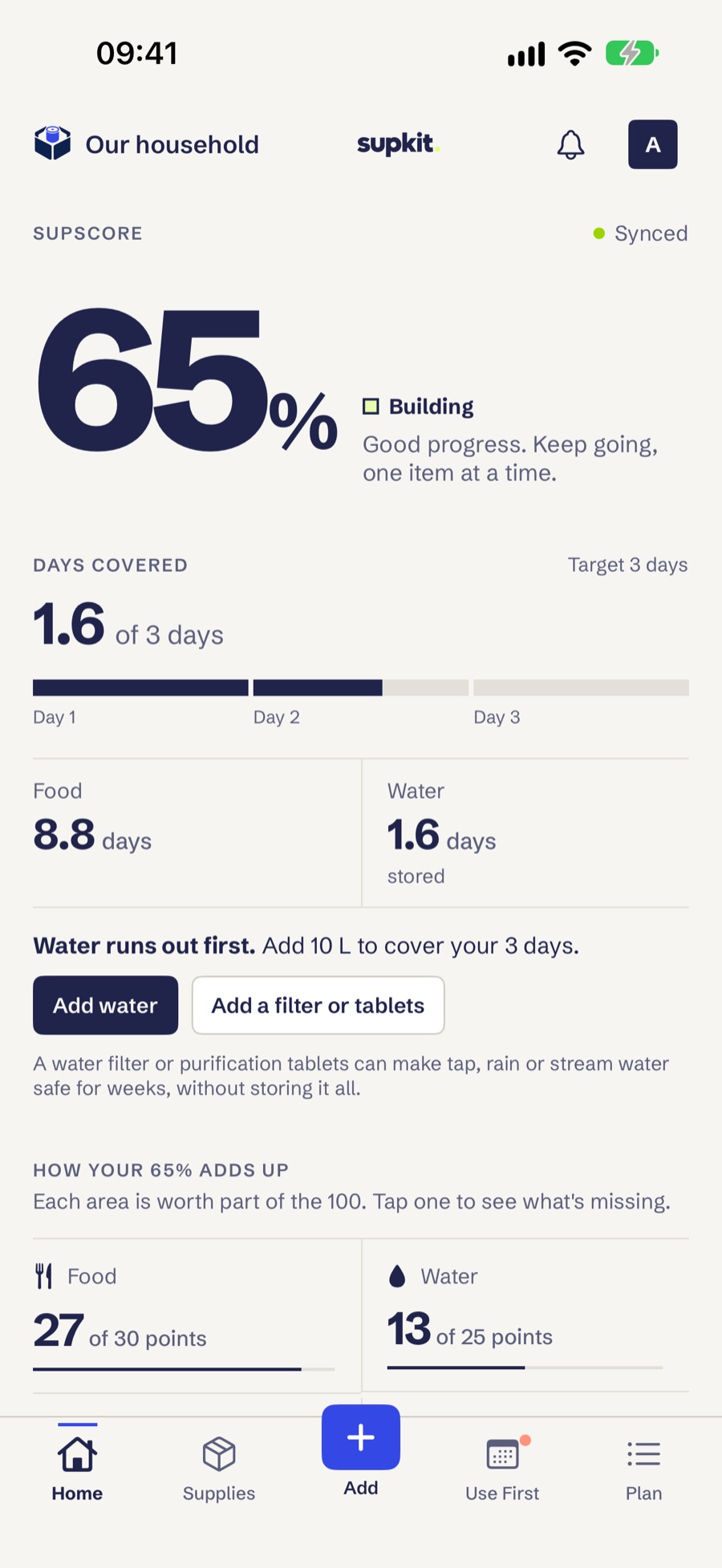
This guide turns that guess into a number you can plan around, using the same figures the SupKit app uses. The calculator above does the maths for your household.
Why quantities vary between households
Food is about energy, and people need different amounts of it. A teenager needs more than a toddler, and an older adult usually needs a little less than a younger one. A household of two adults and a household of two adults with three children are very different shopping trips.
Other things matter too:
- Dietary needs. Allergies, intolerances, coeliac disease, diabetes or a vegetarian or vegan diet all narrow what you can store. Plan around them first, not as an afterthought.
- Babies. Infants need their usual milk or formula and feeding supplies, which are planned separately from everyone else's food.
- Familiar food. In a stressful few days, food people already like gets eaten. Food nobody likes gets left, however good it looked on paper.
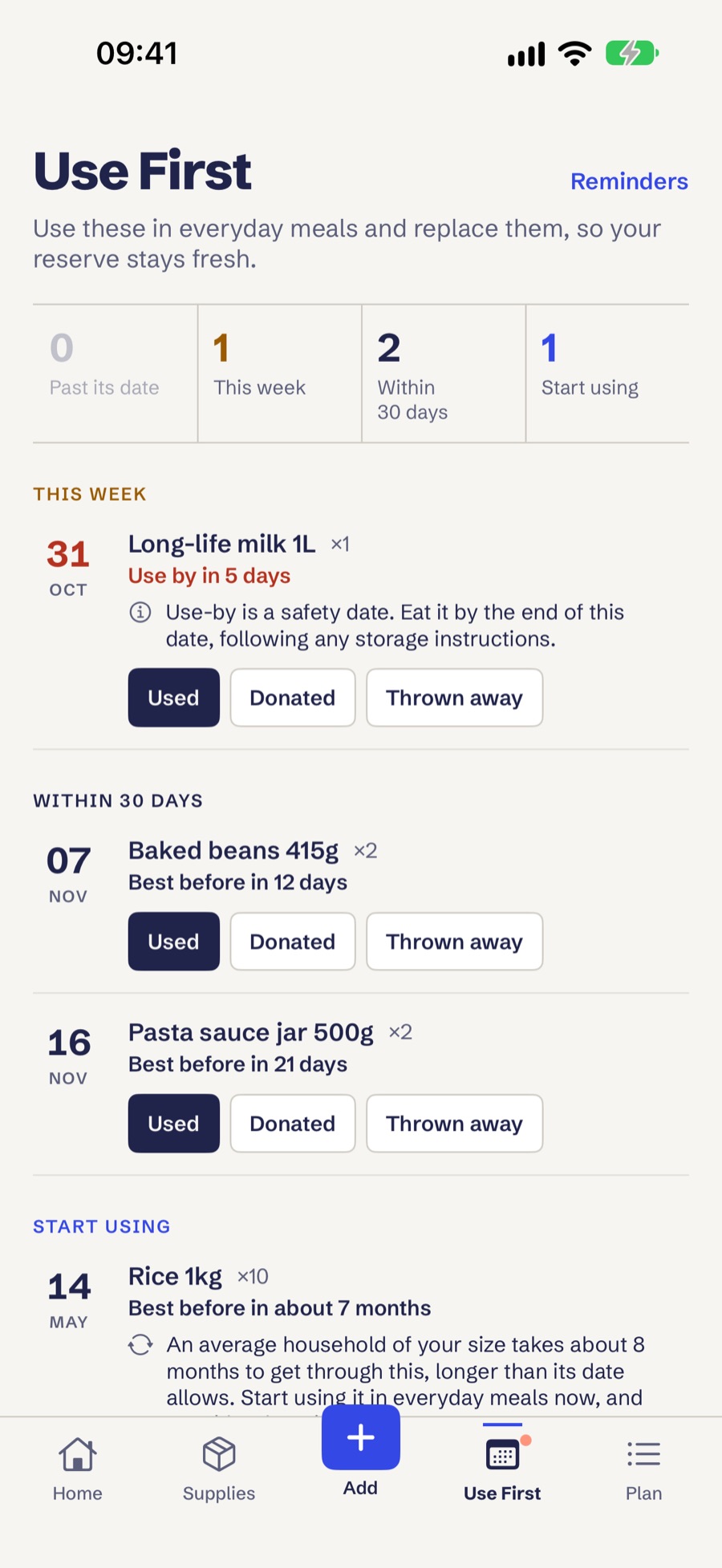
- Food safety. Long-life food only stays safe if it's stored properly and used before its date.
What your household needs each day
SupKit plans food by age band, so a household's total is the sum of the people in it. These are the planning figures the app uses:
| Age band | Energy a day | Drinking water a day |
|---|---|---|
| Baby | Planned separately (feeding supplies) | 3 L |
| Toddler | 4,602 kJ (1,100 Cal) | 3 L |
| Child | 6,694 kJ (1,600 Cal) | 3 L |
| Teenager | 10,042 kJ (2,400 Cal) | 3 L |
| Adult | 9,414 kJ (2,250 Cal) | 3 L |
| Older adult | 8,368 kJ (2,000 Cal) | 3 L |
SupKit's planning figures, the same ones the app uses. SupKit estimate
They are deliberately simple planning figures, not dietary advice. Anyone with a medical condition, a pregnancy or specific nutritional needs should follow the advice they've been given.
Quantities for 3, 7 and 14 days
Here is what those figures add up to for some common households. Use the calculator above for your own.
| Household | 3 days | 7 days | 14 days |
|---|---|---|---|
| One adult | 28,242 kJ (6,750 Cal) | 65,898 kJ (15,750 Cal) | 131,796 kJ (31,500 Cal) |
| Two adults | 56,484 kJ (13,500 Cal) | 131,796 kJ (31,500 Cal) | 263,592 kJ (63,000 Cal) |
| Two adults and two children | 96,650 kJ (23,100 Cal) | 225,518 kJ (53,900 Cal) | 451,035 kJ (107,800 Cal) |
| Two adults, a teenager and two children | 126,775 kJ (30,300 Cal) | 295,809 kJ (70,700 Cal) | 591,618 kJ (141,400 Cal) |
Food energy at SupKit's planning figures by age. SupKit estimate
Official guidance in New Zealand is the place to start for how many days to plan for:
A few days is the usual first goal. A week or two is a sensible next step once the first few days are covered, and it builds naturally if you keep adding a little to your normal shopping.
Turning energy into food on the shelf
Numbers like these are hard to picture, so here's one way the first three days could look for two adults. It's a sample, not a prescription: swap in what your household actually eats.
| Item | How many |
|---|---|
| Tinned chilli | 7 |
| Tinned soup | 8 |
| Baked beans | 7 |
| Microwave rice pouch | 4 |
| Tinned tuna | 6 |
| Crackers | 1 |
| Peanut butter | 1 |
| Dried fruit and nuts | 2 |
| Cereal bars | 1 |
| Tinned fruit | 4 |
One way to reach 56,484 kJ (13,500 Cal) with long-life food. Swap in what your household eats. SupKit estimate
The food quantity calculator turns any one food into a number of packs, and each food guide explains what's on its label and how long it keeps.
Common mistakes
- Counting tins, not days. Ten tins of soup sounds like a lot, but it may cover far fewer days than you think. Work from the energy your household needs.
- Forgetting the people with different needs. A child's allergy or a parent's diabetes changes the whole list.
- Storing food nobody eats. If it never gets eaten in normal weeks, it won't get rotated, and it will end up out of date.
- Forgetting water. Food and water go together; see how much water to store.
- Forgetting a manual tin opener. It's one of the most commonly missed items.
Use the calculator
The calculator at the top of this page uses your household and the number of days you choose. If you'd rather not keep track yourself, SupKit does the sums, watches the dates and tells you what to add next.
Questions
How much food do I need for 3 days?
For two adults, about <strong>56,484 kJ (13,500 Cal)</strong> in SupKit's planning figures. Add each person in your household, as children and older adults need different amounts.
How much food do I need for 2 weeks?
For two adults, about <strong>263,592 kJ (63,000 Cal)</strong>. A family of four needs about <strong>451,035 kJ (107,800 Cal)</strong>. Build up to it gradually rather than buying it all at once.
Does everyone need the same amount of food?
No. Energy needs vary with age, size, activity and health. SupKit plans by age band, and anyone with specific dietary or medical needs should plan around those first.
Sources
- Home emergency checklist, Govt.nz (citing NEMA). Checked 28 October 2026.
- Have emergency supplies (Consistent Messages for CDEM), National Emergency Management Agency. Checked 29 October 2026.
- Allergen labelling for consumers, Food Standards Australia New Zealand. Checked 28 October 2026.
- Botulism, Health New Zealand | Te Whatu Ora. Checked 28 October 2026.
- SupKit planning rules (SupScore 2026.5), SupKit. SupKit's own planning data.
We summarise official guidance in our own words. Always follow advice from your local authorities.